
Join me on my new Substack, THE ECOLOGY OF TOMORROW, where I share spicy reflections on the social, cultural, political, and philosophical intersections of the environmental movement. This was the introductory post, published last week. To get first access to all new posts, become a subscriber.
In September of 2020, I was blocks away from the sparks that started the Almeda fire, one of the most destructive fires in Oregon’s history. When the winds blew in the opposite direction, the two towns along the I-5 corridor of us suffered monumental destruction, while my home was, thankfully, unscathed. The next few weeks were spent in a smoky, apocalpytic haze, with PPM readings occasionally reaching as high as 600—the highest anywhere in the world at the time. When not at work, I passed that dark, haunted time by thinking, dreaming, and planning how I could contribute positively, on a much larger scale, to the climate movement, to prevent such devastation from ever happening again.
When the smoke faded and the world went “back to normal,” I returned to my day job and mostly abandoned the plans I had started to conceive during those dark days. Time passed. Although the urge to contribute meaningfully to the climate movement diminished as I focused on life, my career, and other things, it never fully went away.
Now, four more years later, the chickens have come home to roost. Here I am once again, thinking about the climate movement and why it has failed to gain a meaningful foothold with American citizens, politicians, or corporations. In the face of the catastrophic destruction of the Los Angeles fires; in the face of two massive hurricanes striking the southeast within two weeks of each other; in the face of biblical-level floods displacing over 8 million Pakistanis and killing 1800 more, we care more about the price of eggs at the grocery store than the extinction-level event knocking at our door. When polled about their priorities in the upcoming 2024 elections, Americans rated “dealing with climate change” as their 18th priority out of 20 total. That’s the bottom 10% of policy priorities.
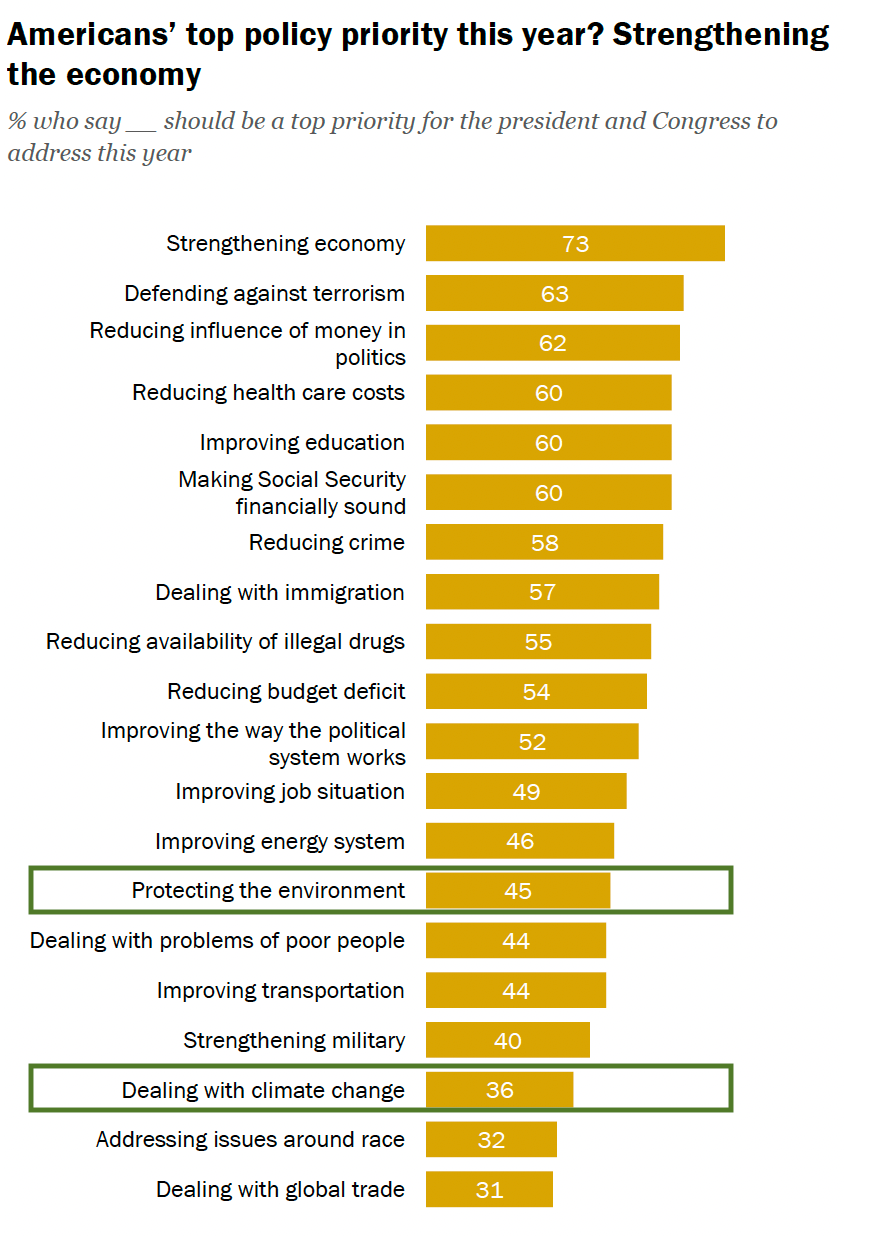
“Protecting the environment” only came in slightly higher, in the 14th spot. Meanwhile, five of the top ten policy priorities involved financial or economic measures of success. Obviously, voters cared more about their pocketbooks and the contents of their refrigerators than rising sea levels or my adopted hometown burning down. These policy priorities played out in real time, with real consequences, as American voters opened our national doors for robber barons and oil oligarchs who have made a suicide pact to plunder the world and divide up the spoils amongst themselves.
In the face of autocracy, despoiling public lands, oil drilling and the greatest mass extinction event in ecological history, what’s an environmentalist to do?
Why, start a Substack, of course.
Over the last eight to ten years, I have thought myself around in circles contemplating this problem, and a few key insights from other thinkers have stood out to me as worthy of exploring, synthesizing, and sharing. I started this Substack to explore these thoughts and ideas through my own lens, and to share those learnings with the world.
Here’s the first big idea worth sharing:
The environmental movement needs Taylor Swift’s PR & marketing strategy.
In other words, how can we make environmental action and policy changes hip, fun, wild, cool, catchy, empathetic, and deeply community-driven? How can we make the environmental movement so irresistibly joyful that everyone in the world wants to be a part of it?
Here’s another:
Tradition and innovation have to come together.
To navigate out of the climate crisis, we will need to draw from both traditional, indigenous sources of wisdom as well as innovative, future-forward technologies that offer energy, transportation, and agricultural solutions effective for a society of our size and scale. I call this eco-futurism, or, more poetically, the ecology of tomorrow, which is the name of this Substack.
Here’s a third:
We all have our role to play in solving the climate crisis. From engineers and teachers to storytellers and politicians, every skill set is valuable as we seek to save our species and myriad others.
This has resonated with me deeply as I have sought a place in this movement. I’m no engineer; I’m no inventor; all I have are the little actions I take every day and the little words I speak into the world.
This Substack, The Ecology of Tomorrow, aims to dive into and blow open the social, cultural, political, and philosophical aspects of the environmental movement. There is a secondary goal to encourage all of us, myself included, to take the individual and collective action that will create mass change and start a climate-centered revolution. Finally, I hope to offer support, ideas, and inspiration to allow everyone to find their own place and voice in the climate movement.
In order for our culture to make this sea change, we have to be radical believers in a futuristic vision where anything is possible. We have to actively dream, imagine, vision, ideate, craft, and create what this ecological solution will be. This Substack aims to explore these dreams through writing. Perhaps one day, a roadmap will emerge which will help to lead us out of the darkness. And then, through radical, individual, and collective action, we will make that dream manifest, and lead the world down a new and different path.
We are the Ecology of Tomorrow. Join me.
You can read and subscribe to my Substack here: https://substack.com/home/post/p-156579522. I look forward to seeing you there.


